by Mike -
This video (2:17 long) shows a Bizzarrini racing with many Ferraris. There is also a white Iso Rivolta GT (at 1:35) in there as well at the Spa Classic in 2011. My apologies for the advertisement, it only last a few seconds.
Subscribe to My Car Quest by email, go to the top of the page on the right side and enter your email address.
Showing posts with label Racecar. Show all posts
Showing posts with label Racecar. Show all posts
Wednesday, September 7, 2011

Thursday, August 25, 2011
Iso Rivolta GT Racing at Laguna Seca
by Mike -
In the video below Pete Whitehead is racing his Iso Rivolta GT at Laguna Seca in Monterey, California in August 2011.
The Iso Rivolta GT has a Corvette 327 cid engine.

Turn up the sound.
Video above by Bruce Caron and photo by Mike Clarke.
Above Adam Carolla interviews Pete Whitehead at Coronado in 2009.
Click on the images for a larger view.

Please share My Car Quest with other car lovers.
Subscribe to My Car Quest by email, go to the top of the page on the right side and enter your email address.
In the video below Pete Whitehead is racing his Iso Rivolta GT at Laguna Seca in Monterey, California in August 2011.
The Iso Rivolta GT has a Corvette 327 cid engine.

Turn up the sound.
Video above by Bruce Caron and photo by Mike Clarke.
Above Adam Carolla interviews Pete Whitehead at Coronado in 2009.
Click on the images for a larger view.

Please share My Car Quest with other car lovers.
Subscribe to My Car Quest by email, go to the top of the page on the right side and enter your email address.
Friday, July 15, 2011
Race Cars Come In All Shapes And Sizes
by Mike -
Different racecars are built for different purposes and different specifications, formulas, that the builders are required to follow.
Here are some racecars that I think are interesting.
1957 Maserati 300S, read more here.

1965 Chevrolet Impala NASCAR Racecar

Dragsters, no turning allowed

1956 BMW Avia Streamliner

1965 McLaren M1A/B


1954 Chrysler New Yorker Panamericana


1965 Shelby GT 350R - one of the very rare R code (R for race). This model won the SCCA Class B championship in 1965. Read more here.

1957 Alfa Romer Giulietta Spyder

1972 Ginetta, a Ford powered British car

1927 Ford Model T, Bonneville Racer


Different racecars are built for different purposes and different specifications, formulas, that the builders are required to follow.
Here are some racecars that I think are interesting.
1957 Maserati 300S, read more here.
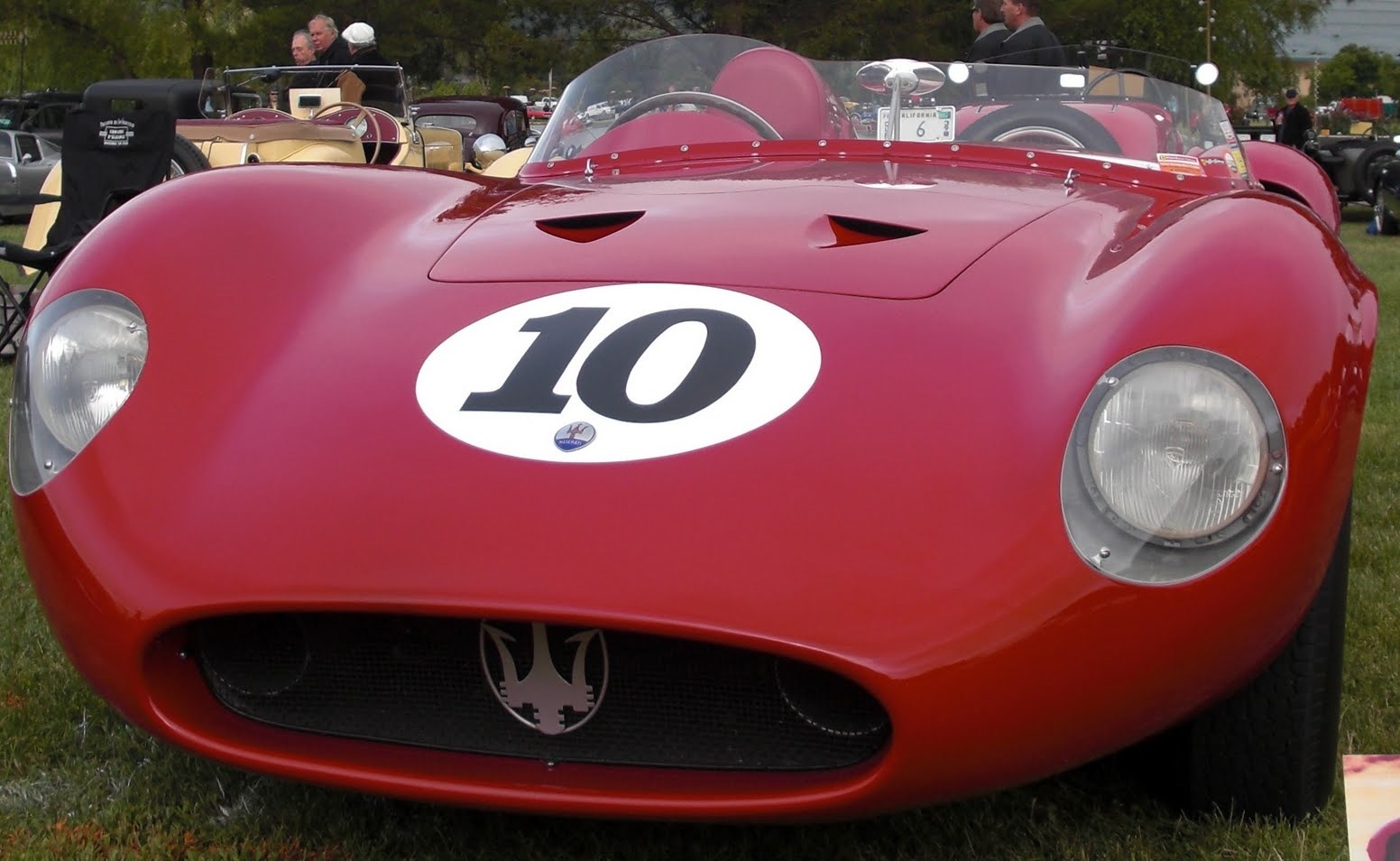
Some are designed to go fast around an oval track where they only turn left, others are designed to go fast around a road course where they turn left and right. And some go fast in a straight line and do not turn at all.
Then there is the street racer which is usually not legal or safe.
1965 Chevrolet Impala NASCAR Racecar

Dragsters, no turning allowed

1956 BMW Avia Streamliner

1965 McLaren M1A/B


Read this history


1957 Alfa Romer Giulietta Spyder

1972 Ginetta, a Ford powered British car

1927 Ford Model T, Bonneville Racer

The Platypus, Ford Bonneville Racer

1932 Ford Roadster, Bonneville Racer

Click on the images for a larger view.


Subscribe to My Car Quest by email, go to the top of the page on the right side and enter your email address.
Thursday, May 26, 2011
Bizzarrini GT 5300 Out Racing
by Mike -
The video below is a Bizzarrini GT 5300 during qualifying, filmed at Zandvoort in Holland and was uploaded to You Tube by ruudmobiel on Sep 20, 2010.
This looks like chassis number BA4 0106 which I wrote about here.

Click on the images for a larger view.


Subscribe to My Car Quest by email, go to the top of the page on the right side and enter your email address.
The video below is a Bizzarrini GT 5300 during qualifying, filmed at Zandvoort in Holland and was uploaded to You Tube by ruudmobiel on Sep 20, 2010.
This looks like chassis number BA4 0106 which I wrote about here.

Oh, what fun this must be!
Click on the images for a larger view.


Monday, May 2, 2011
Bizzarrini Racing at Le Mans
by Mike -
The video below shows Bizzarrini race cars being driven in earnest at Le Mans in 1964-1966.
Sam Posey was the driver who ran into the dirt in the Number 11 GT 5300 (at 1:13 on the video) because of brakes according to Mr. Posey. He was driving chassis number BA4 0106.
Number 11 was a DNF, disqualified because of a pit violation. Posey's co-drivers were Massimo Natili, Pierre Noblet and Regis Fraissinet.

Edgar Berney spins out in the Number 10 P538, chassis number 003, at the beginning of the race (2:54 on the video). It is now believed that this may have been caused by an undisclosed health problem.
Number 10 was a DNF due to a cooling system failure. Berney's co-drivers were Andre Wicky, Frank Ruata and Roberto Bussinello.

This video was made by Gerhard Glazer.
Click on the images for a larger view.

The video below shows Bizzarrini race cars being driven in earnest at Le Mans in 1964-1966.
Sam Posey was the driver who ran into the dirt in the Number 11 GT 5300 (at 1:13 on the video) because of brakes according to Mr. Posey. He was driving chassis number BA4 0106.
Number 11 was a DNF, disqualified because of a pit violation. Posey's co-drivers were Massimo Natili, Pierre Noblet and Regis Fraissinet.

Edgar Berney spins out in the Number 10 P538, chassis number 003, at the beginning of the race (2:54 on the video). It is now believed that this may have been caused by an undisclosed health problem.
Number 10 was a DNF due to a cooling system failure. Berney's co-drivers were Andre Wicky, Frank Ruata and Roberto Bussinello.

This video was made by Gerhard Glazer.
My thanks to Todd Varble.
Click on the images for a larger view.

Saturday, April 23, 2011
Bizzarrini Race Car Chassis BA4 0106
by Mike -
Bizzarrini chassis number BA4 0106, completed in 1965, was the only GT 5300 right hand drive race model built by the Bizzarrini factory. This Bizzarrini competed at not only the 1000kms of Monza and the Targa Florio but also the 1966 24 Hours of Le Mans.


At the end of the 1966 season, the car was fitted with a 7 litre engine and returned to Le Mans in 1967. BA4 0106 was then put into storage for some 35 years and was "lost" for many years. It was mechanically restored a few years ago but retains its original bodywork in these pictures.
It has since been fully restored and has just changed owners in Europe.


Bizzarrini chassis number BA4 0106, completed in 1965, was the only GT 5300 right hand drive race model built by the Bizzarrini factory. This Bizzarrini competed at not only the 1000kms of Monza and the Targa Florio but also the 1966 24 Hours of Le Mans.


At the end of the 1966 season, the car was fitted with a 7 litre engine and returned to Le Mans in 1967. BA4 0106 was then put into storage for some 35 years and was "lost" for many years. It was mechanically restored a few years ago but retains its original bodywork in these pictures.
It has since been fully restored and has just changed owners in Europe.


The next two pictures are period race photos of BA4 0106.


Pictures taken after the full restoration are at DHG Racing.
I have written about another Bizzarrini in Australia with the same BA4 0106 chassis number here. It is not clear why there are two Bizzarrini cars with the same chassis number.
Click on the images for a larger view.

I have written about another Bizzarrini in Australia with the same BA4 0106 chassis number here. It is not clear why there are two Bizzarrini cars with the same chassis number.
Click on the images for a larger view.

Saturday, April 9, 2011
The Cheetah - An Unrealized Potential
by Mike -
Bill Thomas created the Cheetah to compete with the Shelby Cobra in 1963 and produced 16 or 17 between 1963 and 1965. Thomas was able to get the help of Chevrolet in the beginning because they wanted to beat the Ford powered Shelby Cobras at racing.


Bill Thomas created the Cheetah to compete with the Shelby Cobra in 1963 and produced 16 or 17 between 1963 and 1965. Thomas was able to get the help of Chevrolet in the beginning because they wanted to beat the Ford powered Shelby Cobras at racing.

The Cheetah used the Corvette 327 cid engine that was stroked to 377 cid and was able to produce a claimed 520 hp in a car that weighed only 1550 pounds!
While Thomas had some great success in racing Corvettes in the late 1950s and early 1960s he ran into some bad luck with the Cheetah that included politics at General Motors, a lack of funding, inability to meet the homologation production numbers, drum brakes instead of disk brakes and a fire that destroyed the factory and ended the Cheetah's chances of beating the Cobras.
What else could have gone wrong?


Click on the images for a larger view.

Friday, March 25, 2011
How To Create A Great Race Car - The Story of The Scarab
by Mike -
I wrote before about Lance Reventlow and the Scarab Race Car but that article was mostly about Lance Reventlow's fascinating life. Here I want to discuss the classic Scarab cars and the experts who helped Lance Reventlow build these fast cars.

In the late 1950s and early 1960s the Scarab race cars were the best of the best sports race cars. Not only were they great race cars beating Ferraris, Maseratis and Listers but they were beautiful too.
Lance Reventlow was the leader, and funder, of the team that built these race cars. One of the important keys to his success was the team that he assembled. Bruce Kessler, who raced with Lance in the United States and Europe, was the first member of this special team.
Together they toured some of the racing factories in Europe and were influenced by what they saw there, in particular at Lister in Cambridge, UK. Reventlow decided that he could build a better chassis so rather than buy a chassis from Lister he struck out on his own with his company, Reventlow Automobile Inc. (RAI), to design his own chassis. Even Carroll Shelby did not do this.
Warren Olson was a key to Lance's plan, Olson had worked on Lance's previous race cars and he was an expert mechanic and more. RAI was started in Olson's shop in Southern California. Together they recruited Dick Troutman, Tom Barnes, Phil Remington, Emil Deidt, Jim Travers, Frank Coon, Ken Miles and driver Chuck Daigh. Many of these talented people later helped Carroll Shelby design and build the AC Cobra and Shelby Mustangs.

They chose their engine - the Chevrolet small block V8, starting at 283 cid, they went to 301 cid and soon were at 327 cid and later 339 cid. With fuel injection they produced around 360 hp. They used aluminum Borg Warner T-10 transmissions. The beautiful body was designed by Chuck Pelly and built by Emil Deidt who had experience making Indy cars.
The paint scheme was a pearl blue with white stripes and was pinstriped by Von Dutch himself.


My article, Lance Reventlow and the Scarab Race Car was first published by Technorati and the article is also on My Car Quest here.
Click on the images for a larger view.


I wrote before about Lance Reventlow and the Scarab Race Car but that article was mostly about Lance Reventlow's fascinating life. Here I want to discuss the classic Scarab cars and the experts who helped Lance Reventlow build these fast cars.

Lance Reventlow in the Scarab Mk. I, probably at Riverside.
In the late 1950s and early 1960s the Scarab race cars were the best of the best sports race cars. Not only were they great race cars beating Ferraris, Maseratis and Listers but they were beautiful too.
Lance Reventlow was the leader, and funder, of the team that built these race cars. One of the important keys to his success was the team that he assembled. Bruce Kessler, who raced with Lance in the United States and Europe, was the first member of this special team.
Together they toured some of the racing factories in Europe and were influenced by what they saw there, in particular at Lister in Cambridge, UK. Reventlow decided that he could build a better chassis so rather than buy a chassis from Lister he struck out on his own with his company, Reventlow Automobile Inc. (RAI), to design his own chassis. Even Carroll Shelby did not do this.
Warren Olson was a key to Lance's plan, Olson had worked on Lance's previous race cars and he was an expert mechanic and more. RAI was started in Olson's shop in Southern California. Together they recruited Dick Troutman, Tom Barnes, Phil Remington, Emil Deidt, Jim Travers, Frank Coon, Ken Miles and driver Chuck Daigh. Many of these talented people later helped Carroll Shelby design and build the AC Cobra and Shelby Mustangs.

They chose their engine - the Chevrolet small block V8, starting at 283 cid, they went to 301 cid and soon were at 327 cid and later 339 cid. With fuel injection they produced around 360 hp. They used aluminum Borg Warner T-10 transmissions. The beautiful body was designed by Chuck Pelly and built by Emil Deidt who had experience making Indy cars.
The paint scheme was a pearl blue with white stripes and was pinstriped by Von Dutch himself.

The Mk. I had a very successful race career and the Mk. II was soon to follow.
The Mk. II looked similar to the Mk. I but the two Mk. IIs were right hand drive so that the driver was on the inside of most turns on a race track in the clockwise direction as most race tracks were designed. These cars started racing in 1958 and they had a great season, even beating Phil Hill in the best car Ferrari could deliver.

Harry Heuer in a Mk. II at Laguna Seca in October 1961.
After the 1958 season the Mk. IIs were sold by RAI and Lance kept the Mk I and converted it to street use as his personal car.
These Mk. II cars continued to have success racing in the hands of private owners with drivers: Augie Pabst, Carroll Shelby, Jim Jeffords and Harry Heuer. These cars were competitive until 1963 when mid-engine cars became too tough to beat.
My article, Lance Reventlow and the Scarab Race Car was first published by Technorati and the article is also on My Car Quest here.
Click on the images for a larger view.


Saturday, March 5, 2011
Iso And Bizzarrini - Italian Art
by Mike -
The automobile as art begins with the shape, but the engineering and performance must match the beauty of that shape. Iso and Bizzarrini cars do that.
Iso Grifo, Series Two

Iso Grifo, Series Two with an Iso Rivolta in the background.

Bizzarrini Manta.


Click on the images for a larger view.

The automobile as art begins with the shape, but the engineering and performance must match the beauty of that shape. Iso and Bizzarrini cars do that.
Iso Grifo, Series Two

Iso Grifo, Series Two with an Iso Rivolta in the background.


Iso scooter.

Iso Grifo with a little dent.

Iso Grifo A3/C (Bizzarrini).


Flat tire.

Bizzarrini GT 5300 Strada.

Iso Grifo, Series One.


Iso Grifo and Iso Rivolta.

Iso Rivolta close up.


Iso Fidia.

Iso Fidia in California under ice.

Iso Lele.

Bizzarrini P538.

Iso Rivolta race cars.


Subscribe to:
Posts (Atom)